The return started when I finally believed I was worth saving.
This is my story, in my own words — substances, recovery, all of it. But if you take away the specifics, what's underneath is something almost every woman I've ever met recognizes: the slow disappearing act of losing yourself, and the long way back to finding her again.
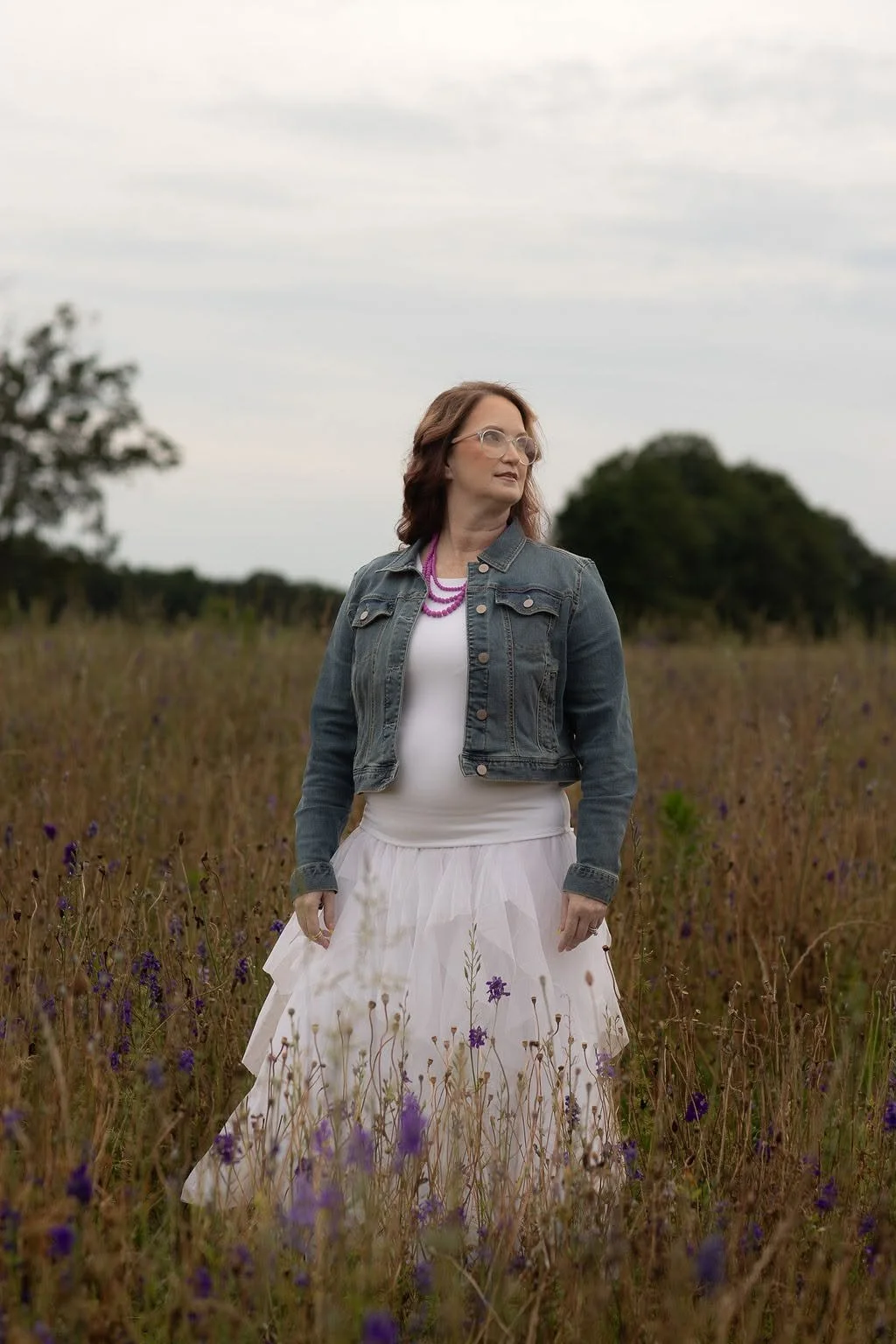
Who I was before
I found alcohol at seventeen. I was shy, insecure, never quite sure how to be myself around new people — and the first time I drank, I remember thinking where has this been my whole life? It made the version of me I wanted to be feel reachable. Outgoing. Easy. Fun. Through college and my twenties, it was just what everyone did — at parties, after heartbreak, at every version of "letting loose." I wasn't worried about it. It was just life.
How it became survival
At twenty-seven I got pregnant with my oldest son and stayed sober through that pregnancy — but it didn't take long for drinking to find its way back. Not long after, bad migraines after his birth led to a prescription for opiates, and I discovered something I'd never felt before: not just relief, but euphoria. It gave me energy. It made me feel like I could do it all — work, parent, show up. For years I didn't understand that this was addiction. I just thought I'd found something that worked.
Eventually the prescriptions dried up, and I came clean — to myself, and to the man I'd later marry, my high school sweetheart who'd come back into my life twelve years after breaking my heart. I told him about the pills. He had no idea. I went through my first detox, tried AA, tried NA — and never felt at home there. It felt dark. It felt like everyone was stuck, and I desperately didn't want to be stuck. I wanted to be free.
So I built a life that looked like recovery from the outside and felt like a treadmill on the inside. Get up. Go to work hungover. Be the wife. Be the mom. Drink myself to bed. Repeat. I told myself this was just what life was. A good life, even — husband, kids, faith, a home. And underneath all of it, I was a ghost.
Maybe you've never had a drink in your life. But if you've ever smiled through a school pickup or a family dinner while feeling like you were watching your own life from outside your body — you know exactly what I mean.
The bottom
Maybe your version of escape doesn't look like mine. Maybe it's not a bottle or a pill — maybe it's overworking, or scrolling, or staying just busy enough that you never have to sit with how empty you feel. The substance was never really the point. The running was.
For me, the running eventually cost us our home. We lost it and moved in with my husband's parents — and even that wasn't rock bottom for me, which tells you something about how far gone I was. I drank more. I hid bottles. I drank before events so people wouldn't see how much I'd already had. My husband watched me disappear in front of him — losing weight, barely eating, somehow still getting up every day to get the kids to school. He loved me through it as long as he could, until the day he had to draw a line: get help and stay, or keep going and go somewhere else. Not as an ultimatum from anger — but as a man watching his wife die slowly and finally saying enough.
I checked myself into a mental health facility. It was awful. I left forty-eight hours later and drank that same day. I lost my job not long after. And there I was — no job, a family that was scared and hurting, and a choice in front of me that I could no longer avoid.
I'm not telling you this so you'll compare your pain to mine and decide it doesn't measure up. I'm telling you because I know what it's like to think you're the only one drowning quietly while everyone around you assumes you're fine.
The choice
One day, sitting at a bar, something in me finally broke open. Not in a dramatic way. Just — clarity. I could choose my family, or I could choose poison. That was it. That was the whole choice, stripped down to its truest form.
I didn't know how to get to something better. I just knew it existed, and I knew I couldn't get there on my own. So, for the first time, I let people help me — and I trusted the process, even when I didn't yet trust myself.
Who I am now
I walked into treatment and was met by people with kind eyes who believed I was worth saving — before I believed it myself. I detoxed safely. I went through months of learning things I'd never learned: how to sit with emotion instead of drowning it, how to ride out a craving instead of obeying it, how to tell the truth about how I felt instead of performing fine.
And slowly, the lights came back on. I could think clearly for the first time in years. I could see a way out of the dark — and more than that, I could see that there was a life out there I hadn't even let myself imagine.
Three years later, I've built two businesses with my husband. I've rebuilt my marriage, my home, my relationship with my kids. And I've come back to my faith — not as performance, but as the foundation underneath everything. There's a verse I hold onto now: "My grace is sufficient for you, for my power is made perfect in weakness." I don't share my story because I'm proud of where I've been. I share it because I know what it's like to believe you're too far gone — and I know, firsthand, that you're not.
What I eventually realized is that recovery wasn't the destination. It was the doorway. The real work was learning how to come home to myself.
Whatever your version of running has looked like — substances, or something else entirely — the way back is the same. You start by believing you're worth coming back for.
You are not broken. You never were. You're worthy of a life you don't need to escape from — and I'm here to help you find your way back to it.
Why I Created The Worthiness Blueprint
Recovery gave me my life back, but it didn't automatically teach me how to live from worth.
What I discovered is that many women aren't struggling because they're broken. They're struggling because they've spent years surviving.
The Worthiness Blueprint exists to help women find their way back to themselves—to the truth beneath the stories, the feelings beneath the armor, the identity beneath performance, and the life they're meant to live.
Because worthiness isn't something you earn.
It's something you remember.